Today
20
in History
26
January
February
March
April
May
June
July
August
September
October
November
December
01
Sun
02
Mon
03
Tue
04
Wed
05
Thu
06
Fri
07
Sat
08
Sun
09
Mon
10
Tue
11
Wed
12
Thu
13
Fri
14
Sat
15
Sun
16
Mon
17
Tue
18
Wed
19
Thu
20
Fri
21
Sat
22
Sun
23
Mon
24
Tue
25
Wed
26
Thu
27
Fri
28
Sat
29
Sun
30
Mon
31
Tue
...
03-19-1953
First Academy Awards telecast on NBC
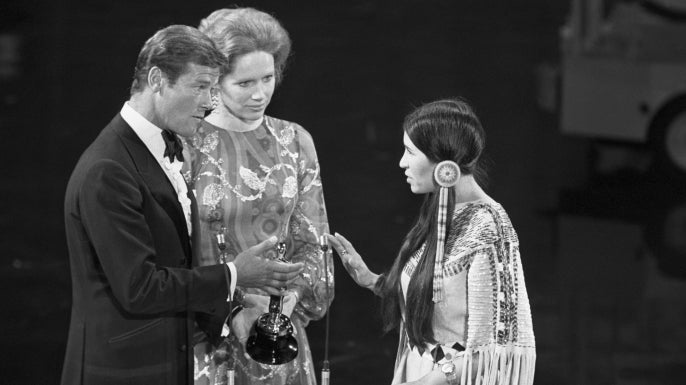
On March 19, 1953, for the first time, audiences are able to sit in their living rooms and watch as the movie world’s most prestigious honors, the Academy Awards, are given out at the RKO Pantages Theatre in Hollywood, California.
Organized in May 1927, the Academy of Motion Picture Arts and Sciences was envisioned as a non-profit organization dedicated to the advancement of the film industry. The first Academy Awards were handed out in May 1929, in a ceremony and banquet held in the Blossom Room of the Hollywood Roosevelt Hotel. The level of suspense was nonexistent, however, as the winners had already been announced several months earlier. For the next 10 years, the Academy gave the names of the winners to the newspapers for publication at 11 p.m. on the night of the awards ceremony; this changed after one paper broke the tacit agreement and published the results in the evening edition, available before the ceremony began. A sealed envelope system began the next year, and endures to this day, making Oscar night Hollywood’s most anticipated event of the year.
Public interest in the Oscars was high from the beginning, and from the second year on the ceremony was covered in a live radio broadcast. The year 1953 marked the first time that the Academy Awards were broadcast on the fledgling medium of television. The National Broadcasting Company (NBC) TV network carried the 25th annual awards ceremony live from Hollywood’s RKO Pantages Theatre. Bob Hope was the master of ceremonies, while Fredric March, a two-time Academy Award winner for Best Actor (for 1932’s Dr. Jekyll and Mr. Hyde and 1946’s The Best Years of Our Lives), presented the awards. The statuette for Best Picture went to Cecil B. DeMille’s The Greatest Show on Earth, while John Ford won Best Director for The Quiet Man. Winners in the top two acting categories were Gary Cooper (High Noon) and Shirley Booth (Come Back, Little Sheba).
Hope, a star of stage and screen who tirelessly performed in United Service Organization (USO) shows for American troops during World War II, would become a mainstay of the new TV medium. He was also the most venerated Academy Awards host, playing MC no fewer than 18 times between 1939 and 1977. NBC broadcast the Oscars until 1961, when the American Broadcasting Company (ABC) took over for the next decade, including the first awards broadcast in color in 1966. Although NBC briefly regained the show in the early 1970s, ABC came out on top again in 1976 and has broadcast every Academy Awards show since. The network is under contract to continue showing the Oscars until 2028.
Ratings for the Academy Awards have been notoriously uneven, with larger audiences tending to tune in when box-office hits are nominated for high-profile awards such as Best Picture. When Titanic won big in 1998, for example, the Oscar telecast drew 55 million viewers; the triumph of The Lord of the Rings: The Return of the King in 2004 drew 44 million. The 80th Academy Awards ceremony, held in February 2008, drew the lowest ratings in the history of the broadcast up until that point, with a total of about 32 million viewers–just 18.7 percent of America’s homes–tuned in to the telecast. Analysts blamed the relative obscurity of the Best Picture nominees—the winner, No Country For Old Men, made a relatively puny $64 million at the box office—and the lingering effects of a Hollywood writers’ strike for the poor viewer turnout.
More news today
loading...