Today
20
in History
26
January
February
March
April
May
June
July
August
September
October
November
December
01
Fri
02
Sat
03
Sun
04
Mon
05
Tue
06
Wed
07
Thu
08
Fri
09
Sat
10
Sun
11
Mon
12
Tue
13
Wed
14
Thu
15
Fri
16
Sat
17
Sun
18
Mon
19
Tue
20
Wed
21
Thu
22
Fri
23
Sat
24
Sun
25
Mon
26
Tue
27
Wed
28
Thu
29
Fri
30
Sat
31
Sun
...
05-13-1919
German foreign minister protests Versailles Treaty terms
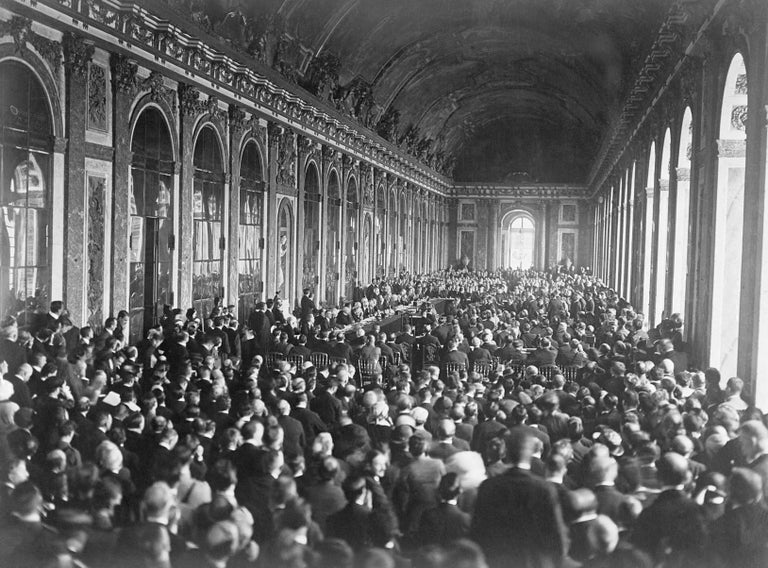
During the second week of May 1919, the recently arrived German delegation to the Versailles Peace Conference, convened in Paris after the end of the First World War, pore over their copies of the Treaty of Versailles, drawn up in the months preceding by representatives of their victorious enemies. On May 13, German foreign minister Ulrich von Brockdorff-Rantzau lodges their written objections to what they considered to be unfairly harsh treatment.
Summing up the objections, Brockdorff-Rantzau wrote, “Those who sign this treaty, will sign the death sentence of many millions of German men, women and children.” He resigned a few weeks to protest his government’s acceptance of the peace treaty terms.
Presented with the treaty on May 7, 1919, the German delegation was given two weeks to examine the terms and submit their official comments in writing. The Germans, who had put great faith in U.S. President Woodrow Wilson’s notion of a so-called peace without victory and had pointed to his famous Fourteen Points as the basis upon which they sought peace in November 1918, were greatly angered and disillusioned by the treaty. As Brockdorff-Rantzau put it: This fat volume was quite unnecessary. They could have expressed the whole thing more simply in one clause—Germany renounces its existence.
Driven by French and British desires to make Germany pay for the role it had played in the most devastating conflict the world had yet seen, Wilson and the other Allied representatives at the peace conference had indeed moved away from a pure peace without victory. Germany was to lose 13 percent of its territory and 10 percent of its population. It was denied initial membership in the League of Nations, the international peace-keeping organization established by the treaty. The treaty also required Germany to pay reparations, though the actual amount ended up being less than what France had paid after the Franco-Prussian War of 1870-71.
The real German objection to the Treaty of Versailles, however, was to the infamous Article 231, which forced Germany to accept sole blame for the war in order to justify the reparations. Despite much debate among the Allies themselves and over strenuous German protests—including by Brockdorff-Rantzau, who wrote to the Allies on May 13 that the German people did not will the war and would never have undertaken a war of aggression—Article 231 remained in the treaty. The Germans were given a deadline of June 16 to accept their terms; this was later extended to June 23. Pressured by the Allies and thrown into confusion by crisis within the Weimar government at home, the Germans gave in and accepted the terms at 5:40 p.m. on May 23.
The Versailles Treaty was signed on June 28, 1919. Meanwhile, opposition to the treaty and its Article 231, seen as a symbol of the injustice and harshness of the whole document, festered within Germany. As the years passed, full-blown hatred slowly settled into a smoldering resentment of the treaty and its authors, a resentment that would, two decades later, be counted—to an arguable extent—among the causes of the Second World War.
Stream World War I videos commercial-free in HISTORY Vault.
More news today
loading...