Today
20
in History
26
January
February
March
April
May
June
July
August
September
October
November
December
01
Sat
02
Sun
03
Mon
04
Tue
05
Wed
06
Thu
07
Fri
08
Sat
09
Sun
10
Mon
11
Tue
12
Wed
13
Thu
14
Fri
15
Sat
16
Sun
17
Mon
18
Tue
19
Wed
20
Thu
21
Fri
22
Sat
23
Sun
24
Mon
25
Tue
26
Wed
27
Thu
28
Fri
29
Sat
30
Sun
31
Mon
...
08-03-1936
The Greatest 45 Minutes in Sports History
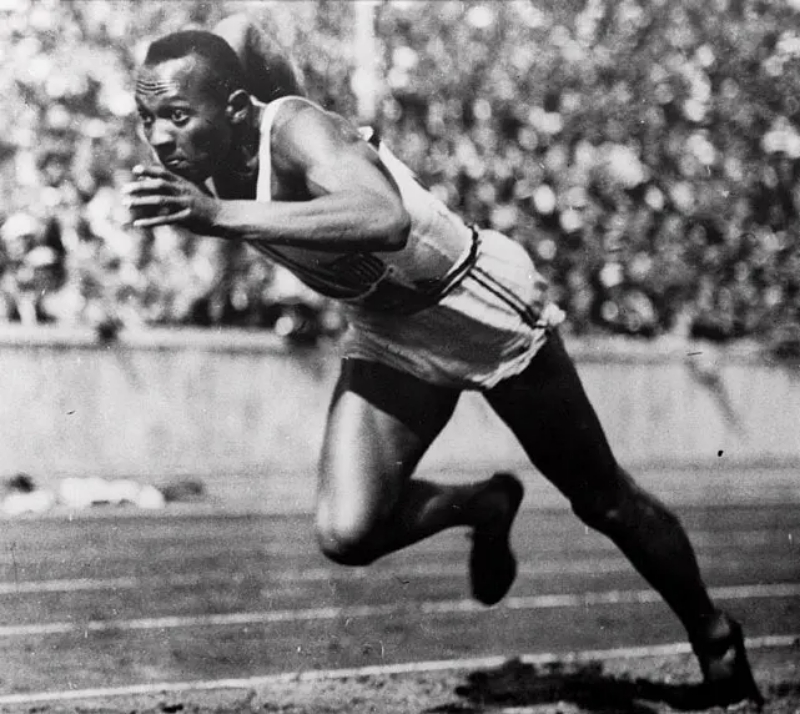
August 3, 1936 — Legendary American athlete Jesse Owens produced in one afternoon what Sports Illustrated described as “the greatest 45 minutes ever in sports history.”
The competition was the Big 10 Conference Championship, which took place at Ann Arbor, Michigan in May, 1935. Owens broke three world records and equalled another in less than an hour.
This amazing performance came despite a serious back injury. Five days before, Owens had fallen down stairs, leaving him with a badly bruised back. According to reports at the time, he had to be helped in and out of the car that brought him to the venue. His coach wanted to pull him out of the competition but Owens insisted on taking part.
He said later that as he settled on his haunches for the first race, the pain he had been feeling “disappeared, as if by a miracle”.
Owens’ unmatched world record extravaganza began at 3:15pm when he completed the 100 yard dash in 9.4 seconds, equalling the world record. Then at 3.25pm he set a new world record for the long jump of 8.13 metres (almost as long as a London double-decker bus and a record that stood for 25 years).
Scarcely pausing for breath, at 3.45pm he set a record for the 200 metres of 20.3 seconds; and finally, at 4pm he ran the 200m hurdles in a record time of 22.6 seconds.
But it was on this day, competing in the Olympic Games in Berlin a year later, that he is probably best remembered. Adolf Hitler had expected the event to demonstrate on the world stage what he believed was Aryan superiority.
The Games had been awarded to Germany in 1931 before Hitler came to power, but by 1936, the anti-Semitic and racist policies of the Third Reich had provoked widespread revulsion and calls for a boycott. However, after a close vote the US team decided to go.
The athletes arrived to find the magnificent 70,000-seat stadium, the Reich Sports Field, bedecked with countless swastikas and iron crosses. And the Nazi propaganda machine had issued bulletins in 14 languages to 3,000 newspapers and magazines around the world espousing Hitler's warped philosophy of a pure Aryan race, and his declared belief in the evils of Jews and the inferiority of blacks.
But black American Owens obviously did not get the message. In one of the greatest performances in Olympic history he won four gold medals in track and field events: the 100-metre sprint, the long jump, the 200-metre sprint, and the 4 x 100-metre relay. The feat would not be matched until American track and field star Carl Lewis won four golds at the 1984 Summer Games in Los Angeles.
As he watched the gold medals being bestowed on Owens, Hitler is reported to have told Balder von Schirach, the Hitler Youth leader: “The Americans should be ashamed of themselves for letting their medals be won by Negroes. I myself would never even shake hands with one of them.”
James Cleveland Owens was born on September 12, 1913, and nicknamed “J.C.” by his family. He was the last of 10 siblings, the son of a tenant farmer, and the grandson of a slave.
Owens was lucky to live beyond the age of five. He had developed a painful golf ball-sized tumour on his chest, made more emotionally agonising by the fact that his family could not afford a doctor. There was only one thing for it: the boy lay on the kitchen table biting a leather strap while his mother cut away the tumour with a sterilised knife. He lost a lot of blood, but survived.
Then the story goes that after moving from his native Alabama to Ohio, a new teacher asked the nine-year-old boy his name. She misunderstood his Southern accent and thought he said “Jesse” instead of his initials. Owens was too shy to correct her and it was Jesse from then on.
He excelled in track events at high school, then enrolled at Ohio State University in 1933, where he became the first African-American captain of the Ohio State Buckeyes track team, smashed a series of track records and earned the nickname “Buckeye Bullet”.
Despite Hitler’s discomfort at the 36 Olympics Germany triumphed with a total of 101 medals, 38 of them gold. Second place went to the US with 57 medals, including 24 gold. One of America’s gold medals was won by 13-year-old springboard diver Marjorie Gestring who became the youngest ever Olympic champion with her victory in the women’s 3-metre springboard event.
* Surprisingly for such a great athlete, Jesse Owens was a smoker for decades. He died of lung cancer in 1980, aged 66.
More news today
loading...